libbrailleReading by touch

An independent publication about braille and tactile reading. A C library called libbraille was once one of the pieces of software that let Linux drive a braille display. This publication is not that software and has nothing to do with it.

libbraille / The Six Dots

Position 1 · The Six Dots

Why the Cell Is Not Bigger

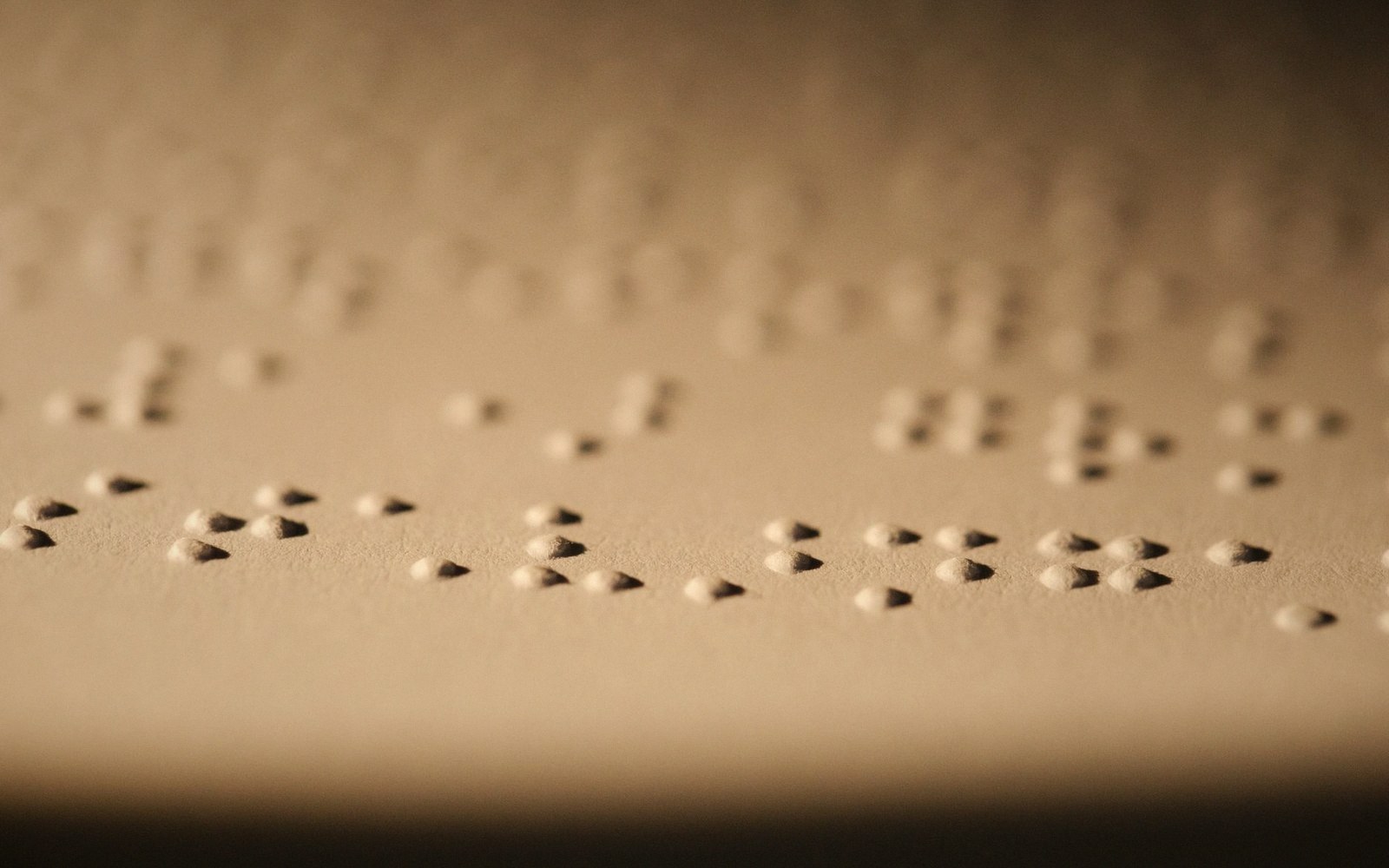
Macro six-dot braille cell dot spacing paper
01

The fingertip is the constraint, not the page

Braille cells are small. The standard cell — two columns of three dots, each dot roughly 1.5 mm in diameter, centre-to-centre spacing of 2.5 mm horizontally and 2.5 mm vertically, with about 3.75 mm between adjacent cells in a line — fits inside a square roughly 6 mm on a side. That size was not chosen arbitrarily, and it was not chosen for the convenience of paper manufacturers or embossing machines. It was chosen, by iteration and empirical use over the nineteenth century, because it sits at the upper boundary of what a trained fingertip can resolve quickly enough to read.

The reason that boundary exists is tactile acuity: the fineness with which the skin can distinguish two separate points of stimulation as distinct rather than fused into one. Measure it on the fingertip pad and you get a two-point discrimination threshold somewhere in the range of 2–3 mm for most adults — meaning two separate point contacts closer together than that register as one. The braille dot spacing of 2.5 mm centre-to-centre sits right at that threshold, and the dots themselves, being raised domes rather than points, are easier to separate perceptually than bare skin-touch experiments suggest, because the dome shape concentrates pressure on a small area. The standard cell is, in short, engineered to the resolution limit of the fastest-reading finger — not the average finger, and not the limit of what can be felt at all, but the limit of what can be identified without slowing down.

02

Why bigger does not help

The obvious objection is: if the dots are near the resolution limit, wouldn't making them further apart make them easier to read? The answer is yes — but only at very slow reading speeds and for new learners. Above a certain dot spacing, the fingertip can no longer hold the whole cell within its sensing window simultaneously, and the reader must either slide the finger across the cell (destroying its gestalt, the whole-pattern recognition that makes fluent braille reading fast) or move the finger between dots (which is not reading at all, it is counting). The useful sensing area under a fingertip pad is roughly 8–10 mm in diameter, and it is not uniformly sensitive across that area: the highest-resolution zone, concentrated at the centre of the pad, is smaller than that. A cell that required the full 10 mm pad to resolve would be a cell that only the very centre of the pad could read, demanding impractical precision of placement.

Tactile acuity research also shows that the sensitivity of the fingertip is not uniform across orientations. Discrimination is slightly better along the finger axis (proximal-distal, toward and away from the hand) than across it. The two-column layout of the braille cell, in which the primary dot positions are arranged vertically in two columns of three, is oriented so that the column containing dots 1, 2 and 3 runs along the preferred axis of the left index finger as it scans left-to-right. That alignment is not coincidental. The spacing between the two columns — 2.5 mm across — coincides with the slightly less sensitive lateral axis, but it still sits within the range the fingertip can resolve reliably. Scale the cell up and you push the inter-column distance past the point where the fingertip can resolve both columns simultaneously, forcing the reading strategy to collapse.

Speed compounds the problem. Proficient braille readers move their fingertip at between 100 and 200 mm per second across a line of text. At that speed, a fingertip contacts each standard cell for roughly 30–60 milliseconds before moving to the next. The tactile nervous system has a temporal resolution of its own: the mechanoreceptors in the fingertip pad — primarily Meissner corpuscles and Merkel discs — encode spatial structure partly through the temporal pattern of firing as the skin moves across texture. If the cell is larger, the crossing time at a fixed reading speed increases, but so does the spatial distance the finger must cover between cell starts. At comfortable sweep speeds, a larger cell introduces a timing mismatch between when the first column's signal arrives and when the second column's signal arrives. The cell becomes two sequential events rather than one simultaneous gestalt. Readers compensate by slowing down, which defeats the purpose.

03

Eight dots: the practical ceiling

Eight-dot braille, used in computer braille and on most refreshable displays, adds a row of two dots below the standard six. The physical arrangement extends the cell vertically by one dot row — typically adding 2.5 mm — bringing the cell height to roughly 8.5 mm. This extension is within the sensing range of the fingertip for static contact, but it pushes toward the edge of the simultaneous-gestalt reading zone for fast lateral sweep. Research and practical use suggest that eight-dot cells are reliably readable by trained users, with the lower two dots often doubling as cursor indicators on refreshable braille displays — which limits the perceptual load. Readers learn to attend to the upper six dots for content and the lower two for device state, effectively partitioning the cell into a familiar six-dot region and a peripheral indicator zone.

The proposition of a ten-dot or twelve-dot cell — three columns rather than two, or five rows rather than three — has been raised in research contexts and rejected each time on consistent grounds. Three columns would require a cell width of approximately 7.5 mm or greater, exceeding the reliable simultaneous-resolution window of the fingertip at reading speed. Five rows would extend the cell vertically well beyond the eight-dot cell's height, at which point only the slowest readers with large fingertips could maintain gestalt recognition. Encoding capacity is not the constraint — a three-column, four-row cell of 12 positions would encode 4,095 distinct non-empty patterns — but encoding capacity has never been what limits the cell. The fingertip limits the cell.

It is worth noting that cell spacing between characters matters as much as cell geometry. The standard inter-cell gap of roughly 3.75 mm (measured centre-to-centre between the rightmost dot of one cell and the leftmost dot of the next) exists to give the finger an unambiguous boundary signal. Reduce that gap and cells begin to bleed into one another perceptually; increase it and reading speed suffers because the finger must travel further per character. Experiments with modified inter-cell spacing consistently find that the standard sits near an ergonomic optimum. A larger cell would require a proportionally larger inter-cell gap, compounding the speed loss.

04

What this means for design

The geometry of the braille cell is essentially settled. The combinatorics of the six-dot cell — 64 patterns including the blank — are the combinatorics available within a human fingertip's resolution at reading speed, and that is the whole story. Every specialised code — music braille, mathematics, chemical notation — works within those 64 patterns because no additional patterns can be added without either slowing reading to uselessness or fragmenting the cell into a multi-sweep encoding scheme. Where braille codes need more symbols than 64 provides, they use mode switching (a preceding indicator cell that changes the meaning of what follows) rather than larger cells. The fingertip imposes a hard constraint, and notation designers work inside it.

The same constraint surfaces in tactile graphics research: embossed lines that are too closely spaced become indistinguishable ridges; textures that encode too much spatial frequency per unit area collapse into undifferentiated roughness. These are the same fingertip physics operating at the same spatial scale. The braille cell, arrived at through empirical practice long before neuroscience could explain it, turns out to be a remarkably precise fit to the biological instrument that reads it.