libbrailleReading by touch

An independent publication about braille and tactile reading. A C library called libbraille was once one of the pieces of software that let Linux drive a braille display. This publication is not that software and has nothing to do with it.

libbraille / The Machines

Position 4 · The Machines

The Perkins Brailler from the Inside

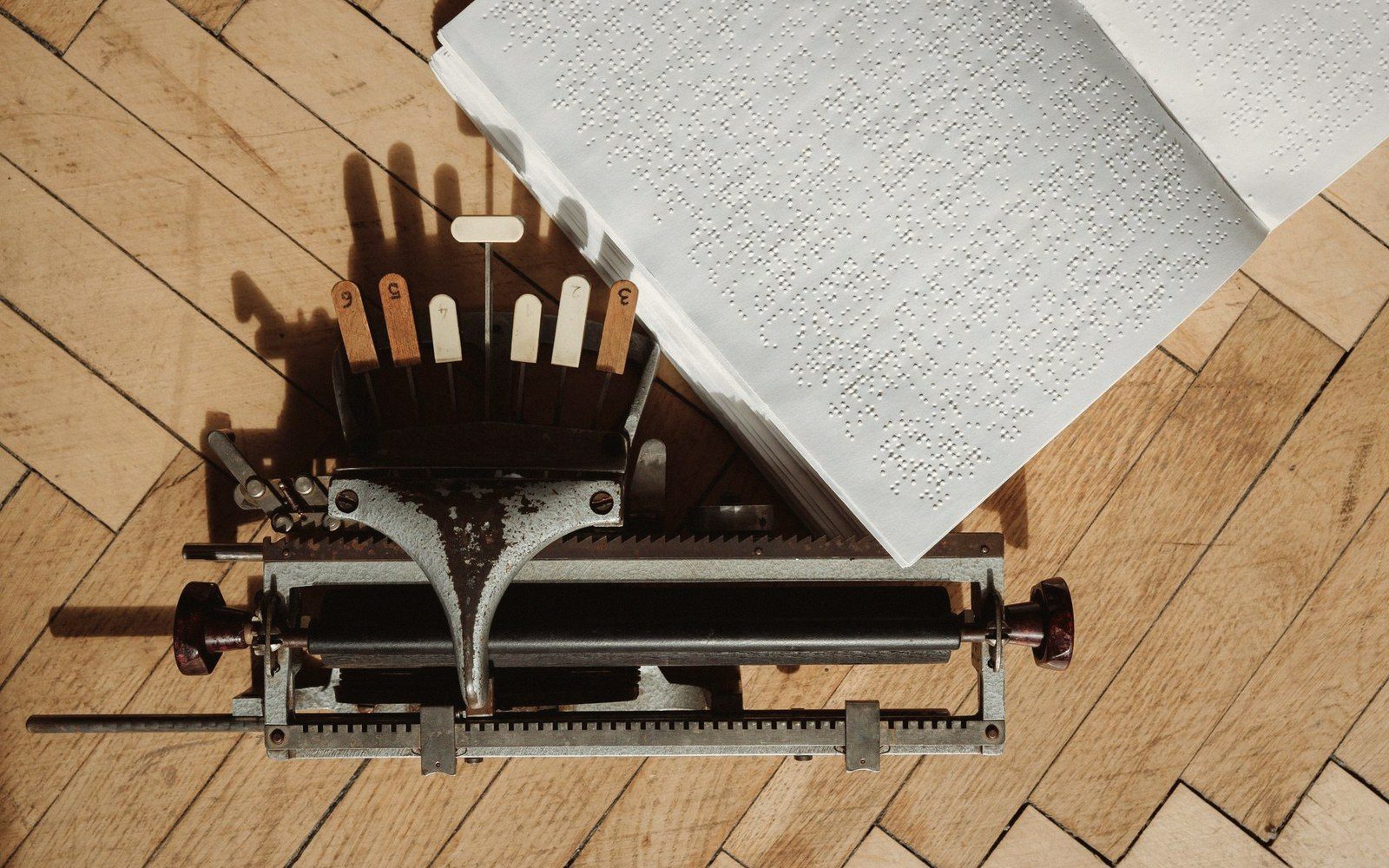
Perkins Brailler seven keys close-up arrangement
01

A keyboard with one job

Seven keys, one lever, one bar: the Perkins Brailler's operating surface is almost aggressively simple. Each of the six embossing keys corresponds to one dot position in the braille cell — dot 1 through dot 6 in the standard arrangement, three on the left for the left hand, three on the right for the right. The seventh key, the space bar, sits centered below. Press any combination of the six keys simultaneously and release; the machine embosses exactly the dots you selected, advances the paper one cell-width, and is ready for the next character. That sequencing — emboss, then advance — is not electronic. It is purely mechanical, and understanding it means following the force from finger to foil.

Each embossing key is linked to a corresponding punch — a small steel rod with a rounded tip. When a key depresses, its punch moves toward the paper from below, while a fixed die plate on the opposite side provides the anvil. The paper is trapped between the two. Where punch meets die, a dot rises. Because all six punches can be driven simultaneously in a single keystroke, a full six-dot cell is formed in a single mechanical event rather than six successive ones. This is what makes simultaneous chord-keying both natural and mechanically necessary: sequential punching would require a far more complex sequencing mechanism, and the resulting dots would not align uniformly within the cell.

02

Feed, space, and backspace

Paper advance is handled by a ratchet mechanism. After each chord is released, a pawl indexes a toothed wheel forward by one fixed increment — the cell width, approximately 6.1 mm in standard-spaced Perkins output. The ratchet is not driven by a motor; it is driven by the return stroke of the embossing mechanism itself. As the keys come back up under spring tension, that motion is coupled through a linkage to advance the paper carriage. Feed and emboss are therefore one continuous mechanical cycle: downstroke embosses, upstroke advances. Miss a beat and the spacing suffers, which is why a trained user develops a steady, rhythmic keystroke rather than a hesitant one.

The carriage — the assembly that holds and moves the paper — rides on a rail and is pulled across by a spring-loaded drum. This is the same basic arrangement found in manual typewriters of the same era: a coiled spring under constant tension draws the carriage incrementally with each ratchet advance. A line-advance lever at the left end of the machine both indexes the paper upward by one line and returns the carriage to the right margin, exactly as a typewriter carriage return does. The paper guide and margin stops are adjustable, though in practice most users work from the default settings for standard braille paper.

Backspacing is where the mechanism earns close attention. The backspace key disengages the ratchet and allows the carriage to move one cell-width back toward the right under manual pressure — but it does not undo the embossing already made. The punches have permanently deformed the paper; no mechanism reverses that. Backspace exists solely to position the carriage so a corrected cell can be embossed on top of the original. If the original dots happen to land inside a fresh cell's dot positions, the paper may be punched twice and the dot deepened or distorted. Correction, in short, is approximate.

The Perkins Brailler was designed by David Abraham at the Perkins School for the Blind in the late 1940s and has changed remarkably little in its core mechanism since. The spring tensions, the pawl geometry, the punch-to-die clearance — all were set empirically to produce a dot of the right height and width for reliable tactile reading. That those calibrations have not needed fundamental revision in seven decades says something precise about how well the mechanical problem was solved the first time.