libbrailleReading by touch

An independent publication about braille and tactile reading. A C library called libbraille was once one of the pieces of software that let Linux drive a braille display. This publication is not that software and has nothing to do with it.

libbraille / The Six Dots

Position 1 · The Six Dots

The Night-Writing Problem

Barbier's military cipher became a dead end. Braille didn't improve it — he replaced it.

Barbier twelve-dot cell beside six-dot braille cell diagram
01

A Code for Darkness

Charles Barbier de la Serre was a French artillery officer who, sometime in the early nineteenth century, developed a system of raised dots for encoding messages that could be read without light. The military problem was real: commanders needed to pass written orders at night without the giveaway of a lantern. Barbier's solution was écriture nocturne — night writing — a phonetic grid that assigned combinations of dots to sounds, not letters.

The system used a twelve-dot cell: two columns of six dots each. Each cell encoded one sound by specifying its row and column position in a phonetic table — up to six dots raised in the left column to indicate one coordinate, up to six in the right column for the other. A reader had to count dots, hold the position in mind, consult the table mentally, and reconstruct the sound. The process was analytical and slow. Barbier's own institution, the French military, never adopted it.

What the system lacked was a unit small enough to sit under a single fingertip. A cell six dots tall and two wide cannot be grasped in one touch; the finger must track down the column to count. Reading became arithmetic.

02

From Phonemes to Letters

Barbier brought his system to the Institution Nationale des Jeunes Aveugles in Paris in 1821. The school was already using embossed Roman letters — legible to sighted teachers, slow and imprecise for blind readers navigating raised curves. Barbier's dots were a genuine improvement in principle: discrete points are easier to distinguish by touch than continuous curves. Students used the system and found it faster than embossed type.

Louis Braille was twelve years old and had been blind since the age of three. He saw exactly what was wrong with Barbier's design. The twelve-dot cell was too tall. Phonetic encoding meant that spelling — and therefore literacy, in any conventional sense — was lost. A text in night writing could not reproduce proper names accurately, could not distinguish homophones in writing, and mapped onto French sounds in ways that did not transfer to other languages. It was a transcription system for speech, not a writing system for text.

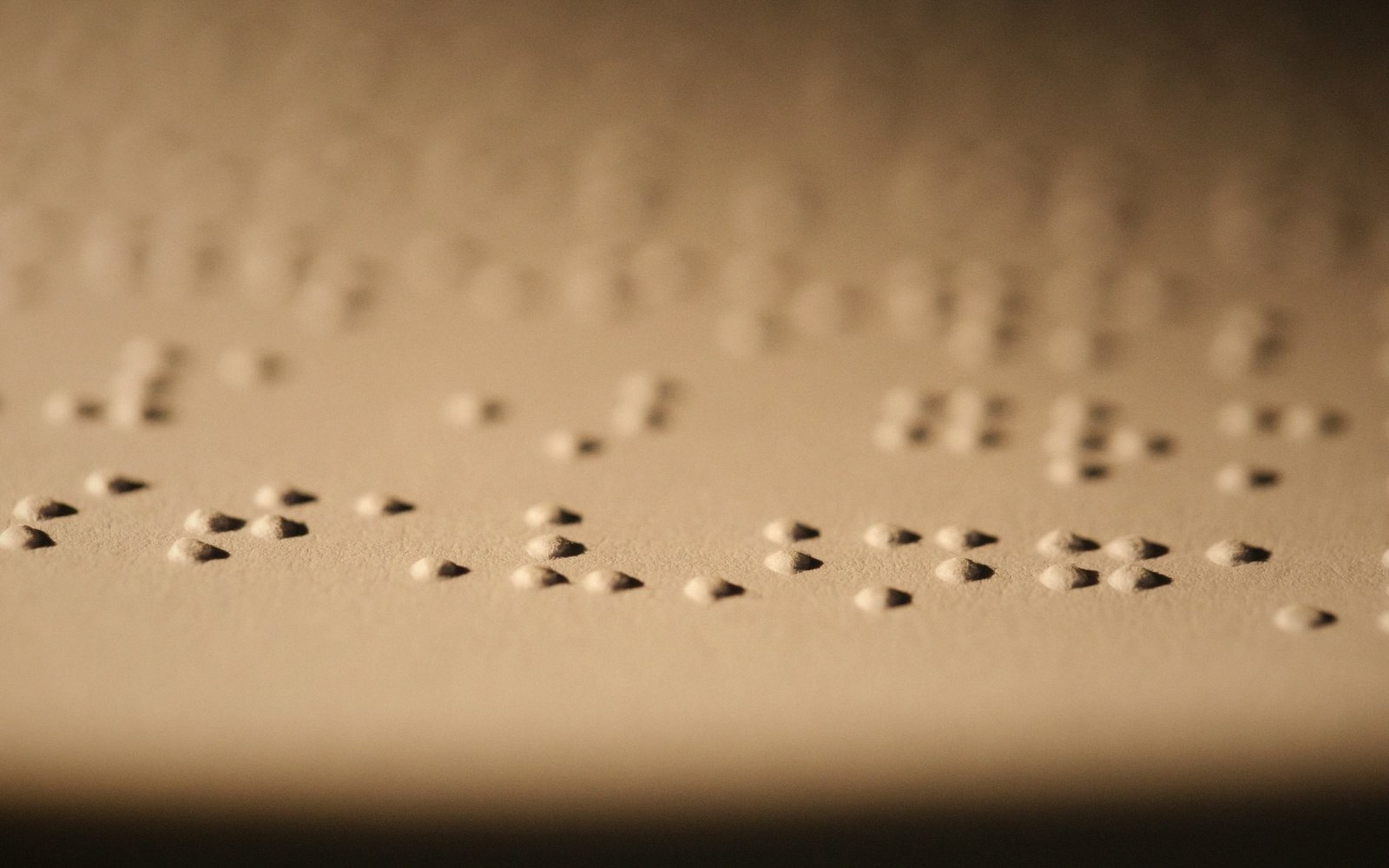
Braille worked on the problem through his adolescence. By 1824, at fifteen, he had a working system. The core move was reduction: six dots, arranged in two columns of three, forming a cell small enough that a single fingertip rests on the whole pattern simultaneously. The reader does not count — they feel the shape. Crucially, Braille abandoned phonetic encoding entirely and mapped each cell to a letter, numeral or punctuation mark. The new system was alphabetic.

The sixty-four patterns a six-dot cell can produce — including the blank — are enough to cover a full alphabet, numerals and common punctuation, with cells left over for the contractions that later reduced the bulk of braille books. Barbier's twelve-dot cell, by contrast, generated a much larger combinatorial space than his phonetic table required, and none of it was used efficiently.

03

What Braille Solved

The night-writing problem, as Barbier framed it, was military and contextual: how to read in the dark without a light source. The solution he produced was barely workable for that narrow purpose and useless for general literacy.

What Braille solved was different: how to encode a complete written language in a tactile medium sized to human fingertip resolution. The answer was a smaller cell, an alphabetic mapping, and a system disciplined enough to carry contractions, mathematics and music within the same structural logic. Barbier's twelve dots asked fingers to do the work of eyes. Braille's six asked them to do something fingers are already good at — recognising a small raised shape whole.