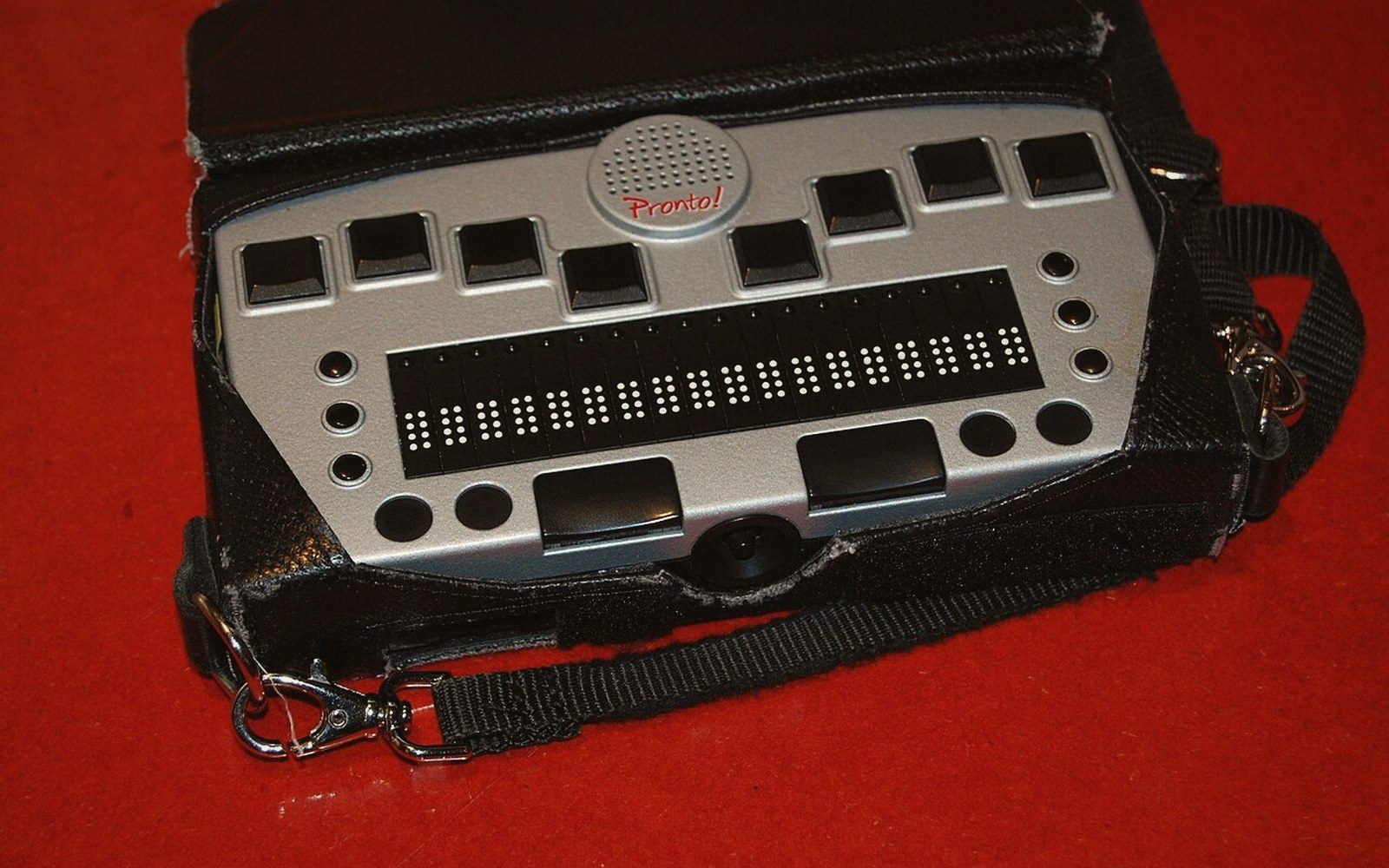
Every Display Spoke a Different Language
In the 1990s and early 2000s, refreshable braille displays arrived on the Linux desktop without a coherent software infrastructure to support them. Each manufacturer — Handy Tech, Alva, Baum, Freedom Scientific — shipped hardware built around proprietary communication protocols. A driver written for one device did nothing useful for the next. For screen-reader developers, this was not a nuisance but a structural barrier: supporting ten displays meant writing ten independent drivers, each requiring separate maintenance as firmware changed.
The problem had a specific shape. A piezoelectric braille cell uses actuators that must be addressed through the host operating system, and that addressing requires a software layer translating abstract braille output into the exact byte sequences each device expected over USB or serial. On Windows, some manufacturers supplied their own drivers; on Linux, users were largely dependent on whatever a volunteer developer had managed to reverse-engineer. The result was uneven coverage and frequent breakage.
Several projects attempted to impose order. BRLTTY — a background process that intercepts screen output and routes it to a display — built its own internal table of device protocols and became the dominant solution for console access on Linux. It remains actively maintained. Alongside BRLTTY, the libbraille C library took a different approach: a shared library that applications could link against directly, offering a unified API across a range of supported displays without routing everything through a single daemon. It gave developers a cleaner integration point, particularly for graphical applications that did not fit neatly into BRLTTY's model. libbraille was not the only such library, but for a period it was an important piece of the Linux accessibility stack.
The fragmentation was never fully solved by any single project. What eventually eased the situation was convergence at the hardware level — USB HID profiles, and later the Bluetooth HID standard, gave manufacturers common communication ground — and the consolidation of BRLTTY and AT-SPI2 as the de facto Linux accessibility stack. Today's displays are broadly better supported, but the underlying tension between manufacturer diversity and driver maintenance remains. Each new device still requires someone, somewhere, to write the code.