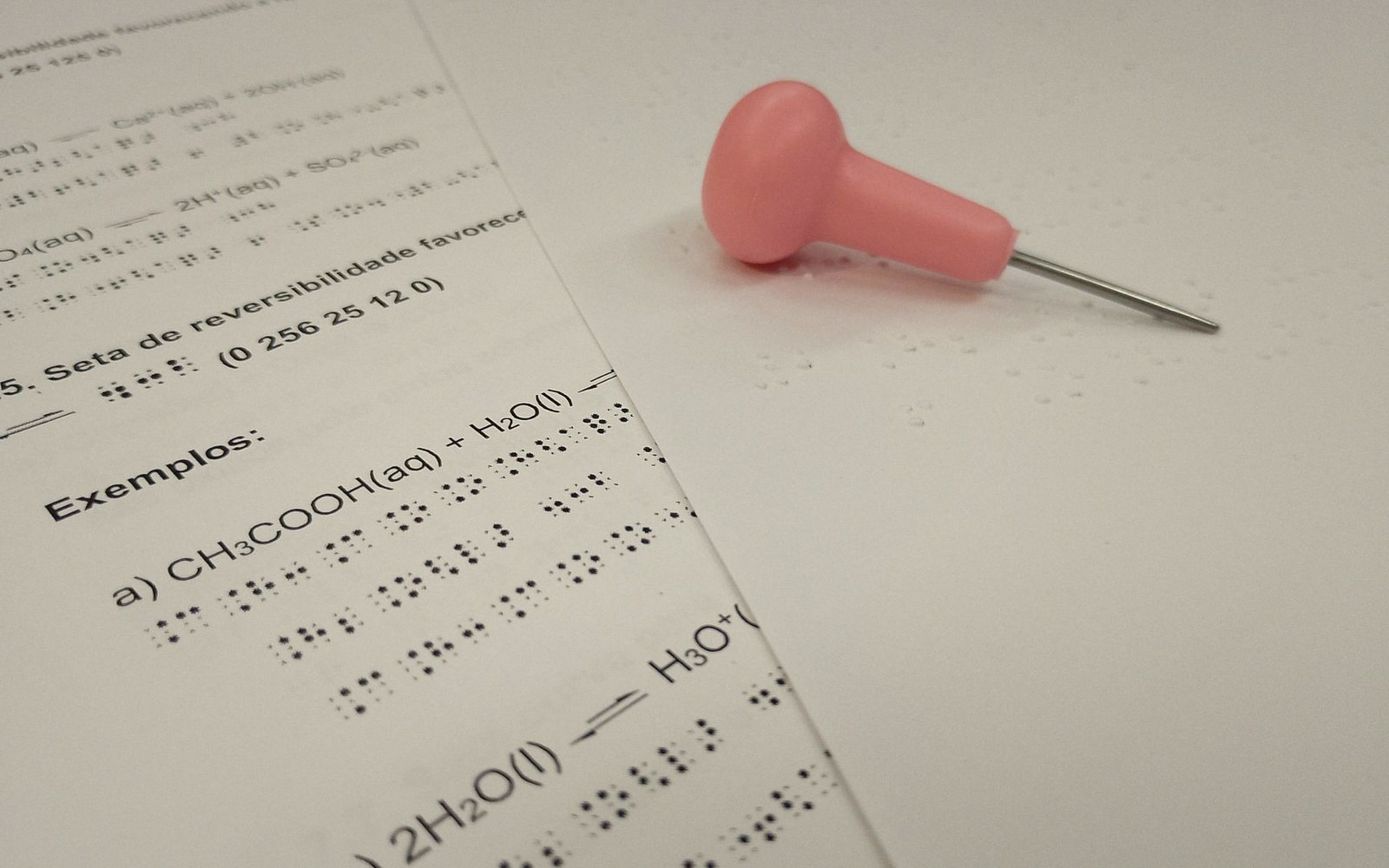
The visual problem
A structural formula like that of benzene — six carbons in a ring with alternating double bonds — carries spatial information that ink-print encodes in two dimensions simultaneously. The ring shape is the meaning. Linear text can approximate it; a linear braille code must do so without the reader ever seeing the whole structure at once, one cell at a time under a moving fingertip.
This is not the same problem that mathematics poses. Nemeth Code and its equivalents handle superscripts, fractions and operator precedence through mode-switching and prefix conventions — the structure is complex but ultimately linear in conception. A branching carbon chain, a ring closure, a stereochemical wedge bond: these are genuinely two-dimensional objects, and forcing them onto a line requires explicit conventions for describing spatial relationships that ink-print simply draws.