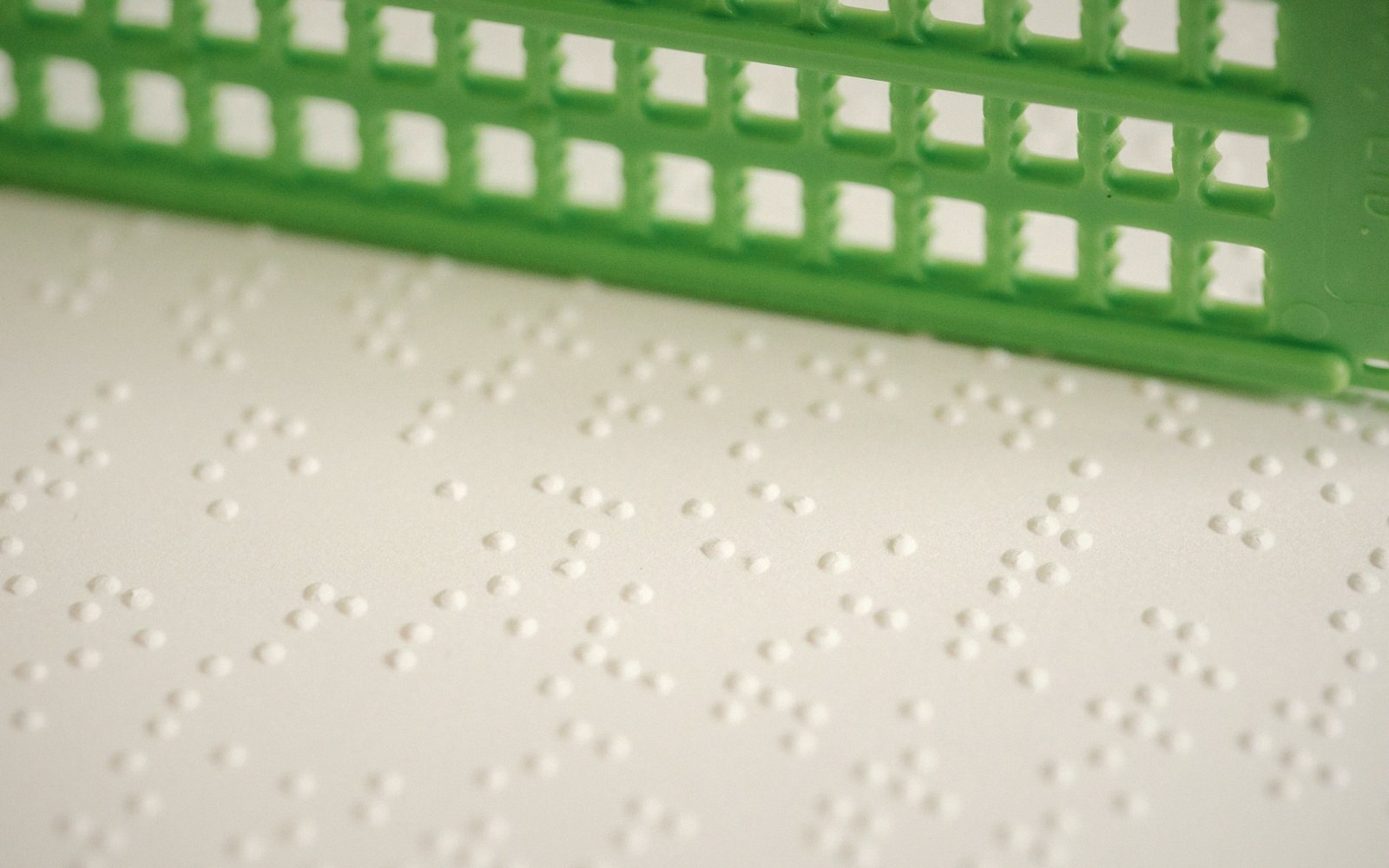
A notation built for a linear medium trying to carry two-dimensional content
Mathematical notation poses a structural challenge that prose does not. An equation like a quadratic formula sits on a page as a spatial object — fractions stack vertically, radicals extend horizontally over their radicands, superscripts float above baselines, subscripts sink below them. A sighted reader scans this two-dimensional space fluidly. Braille has no vertical axis. Every cell follows the one before it in a strict horizontal chain, and every piece of mathematical meaning must be unpacked into that chain without losing any information. Nemeth Code, developed by the blind mathematician Abraham Nemeth and standardised in the United States from the 1950s onward, is the most systematic answer yet devised to that problem.
Understanding Nemeth begins with understanding what it is not. It is not a layer added on top of literary braille, re-assigning a handful of cells for mathematical symbols. It is a separate, self-consistent code that reassigns the entire braille symbol space according to mathematical priorities. In literary braille, a given cell may stand for a letter or contraction, while in Nemeth the same pattern can represent a digit or a mathematical symbol entirely unrelated to that meaning. This is intentional and thoroughgoing: Nemeth prioritises numeric legibility and symbol density over compatibility with literary braille cells. The consequence is that a document mixing prose and mathematics must switch between the two codes, and those switches must be signalled explicitly.