libbrailleReading by touch

An independent publication about braille and tactile reading. A C library called libbraille was once one of the pieces of software that let Linux drive a braille display. This publication is not that software and has nothing to do with it.

libbraille / Notation

Position 3 · Notation

Music Braille Has No Staff

The five-line staff is not translated into braille — it is abandoned entirely. Music braille is a different encoding of the same information.

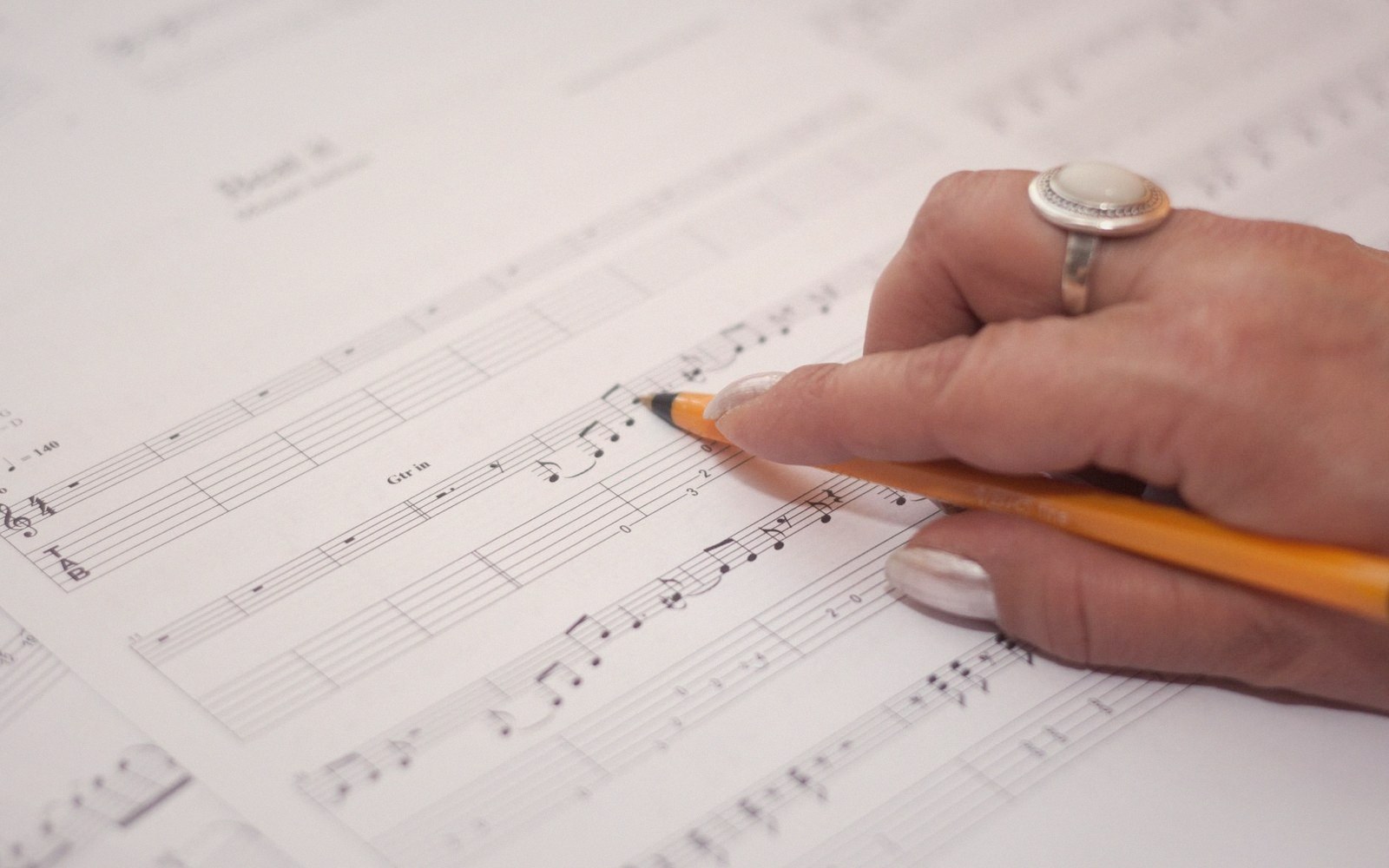
Printed sheet music bars alongside braille transcription
01

The Problem the Staff Solves — and How Braille Solves It Differently

Print music notation is a two-dimensional system. Pitch is encoded spatially: a notehead sitting on the third line from the bottom means something different from one sitting in the first space. Duration is encoded by the shape of that notehead and its stem. The eye reads both dimensions simultaneously, and the hand or voice translates them together.

Braille is a one-dimensional stream of cells. There is no vertical axis, no spatial position to exploit. A music braille cell cannot sit "higher" or "lower" on a page in any way the fingertip can detect. So the entire logic of the staff has to be dismantled and rebuilt as a sequential code — one where pitch and duration are packed into a single cell, and where everything the eye grasped at a glance must instead be spelled out in order.

The solution the International Music Braille system (standardised through the work of the Braille Authority of North America and equivalent bodies elsewhere, and documented in the New International Manual of Braille Music Notation) uses is elegant in its compactness: a single braille cell encodes both pitch class and duration simultaneously. The upper four dots (dots 1, 2, 4, 5) carry pitch; the lower portion modulates duration. The cell for a quarter-note C and the cell for an eighth-note C are different cells. The cell for a quarter-note D is different again. The system maps the seven pitch names, each in several duration values, onto the available cell patterns, and the reader holds the current octave in memory rather than reading it from a staff position.

02

Octave Marks, Rests, and Everything the Staff Implied

Because there is no staff to anchor pitch to an octave, music braille uses explicit octave marks — dedicated cells that appear before a note to declare which octave it belongs to. Octave 4, in the standard numbering, contains middle C. When a melody stays within a single octave, marks appear only at the start and when the music leaps far enough to create ambiguity; stepwise motion within an octave does not require a mark on every note. The reader builds a running model of register, updating it when an octave mark arrives or when the interval is large enough to require disambiguation.

Rests use their own cell patterns, distinct from note cells. Dynamics — piano, forte, crescendo — are encoded with prefix signs drawn from the literary braille cell inventory but assigned entirely new meanings in the music context. This is a key structural feature of music braille: it is a mode, not a separate alphabet. A cell that means "p" in literary braille means piano here, not the letter. The transition into and out of music mode must be clearly marked in a score that mixes text and notation.

Articulation marks — staccato, tenuto, accent — are pre-note signs. Slurs and ties use their own indicators. Chords are written as a melody note followed by a series of interval signs that describe each added note relative to the principal note. The whole system is relentlessly linear: every element that print notation handles with a spatial shortcut must instead appear explicitly in the stream.

03

Bar-Over-Bar Is a Layout Habit, Not Part of the Code

Print music is read in a particular spatial arrangement — the grand staff for piano, with treble and bass clef aligned vertically so the hands can be read together. Music braille has no equivalent spatial alignment. The standard layout approaches are bar-over-bar, line-over-line and sectional, and neither is part of the encoding standard itself. They are transcription conventions — decisions made by the person preparing a score about how to distribute cells across a page.

In bar-over-bar layout, corresponding measures of different voices or staves are grouped together, with the right hand written first and the left hand below it in a new braille line, before the next measure begins. In line-over-line, entire sections of one part are written out before the other part begins. Both approaches require the musician to memorise a section of one hand before reading the other, since the fingertip cannot hold two lines simultaneously the way an eye can scan a grand staff. This is not a deficiency in music braille as a code — it is a consequence of the one-dimensional channel through which all tactile reading must pass.

The practical implication is that learning a piano piece from braille involves a different workflow from learning it from print. A braille reader typically learns the hands separately by feel and memory before combining them — a process that can develop exceptional aural and muscular memory, but that requires music braille to function as a time-sequential encoding rather than the simultaneous visual display print provides.

The code is mature: its current international form traces through work consolidated in the twentieth century, and it handles everything from plainchant to contemporary scores with extended techniques. What it cannot do is preserve the spatial logic of the staff. It doesn't try to.