libbrailleReading by touch

An independent publication about braille and tactile reading. A C library called libbraille was once one of the pieces of software that let Linux drive a braille display. This publication is not that software and has nothing to do with it.

libbraille / Tactile Beyond Braille

Position 5 · Tactile Beyond Braille

Reading Is a Tracking Problem Before It Is a Decoding Problem

Symbol recognition gets the attention. The harder job is knowing where you are on the page.

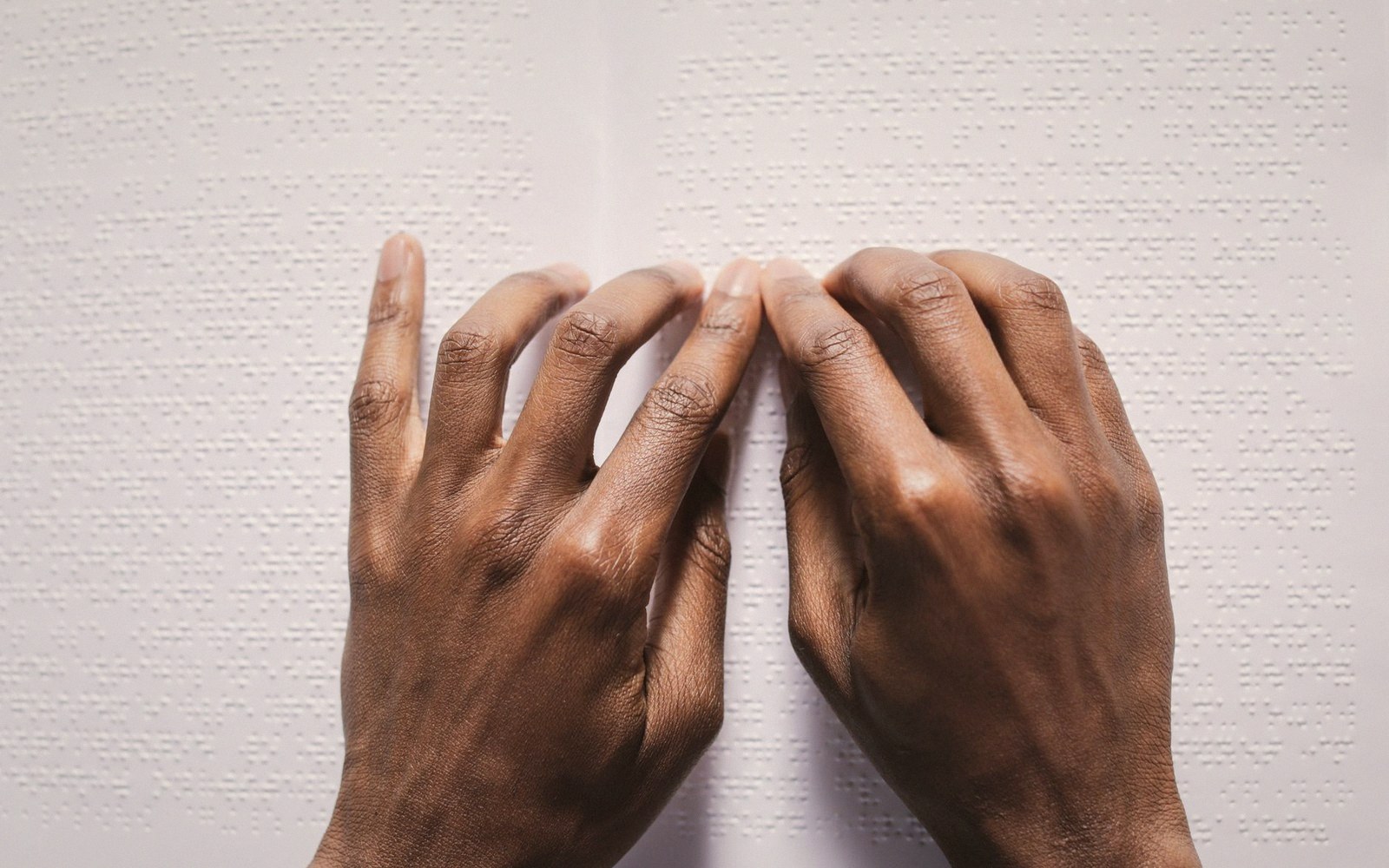
Two adult hands split-reading braille page
01

The Assumption Baked Into Braille Research

Most research into braille literacy treats the central difficulty as decoding: a reader encounters a cell, identifies its dot pattern, and retrieves its meaning. Training programs are built around this model. Assessment measures it. When a learner struggles, the intervention usually targets symbol recognition — more practice with contractions, more exposure to cells in isolation. The model is not wrong, but it is incomplete in a way that matters enormously for how tactile materials get designed.

Decoding a braille cell is, in fact, a solved problem for any reader past the early learning stage. A proficient reader does not consciously identify dots 1, 2, and 4 and retrieve the letter "b." The pattern fires as a whole, the same way a sighted reader does not parse individual letterforms. What proficient braille readers report — and what observational research confirms — is that the persistent difficulty is not recognition. It is place-keeping: knowing which line you are on, where you are within a line, and how to return to the correct position after any interruption. The cognitive load that never fully disappears is spatial, not lexical.

This is not a surprising finding once you examine what tactile reading physically requires. A sighted reader can glance back at a page, relocate a paragraph visually in under a second, and re-enter the text. A braille reader who loses position must search: sweeping left to find the line boundary, counting lines from the top or bottom, re-acquiring context. On a long document, a momentary lapse in attention does not cost a word — it can cost a minute of recovery. The medium is purely serial and purely local. There is no peripheral vision to maintain a map of the whole page, no gestalt impression of layout to anchor the reading hand.

02

Why Spatial Tracking Dominates Tactile Cognition

The constraint begins with fingertip resolution. A trained braille reader reads with one or two fingertips, typically the index fingers of one or both hands, sweeping horizontally across a line. The reading area of a fingertip is small: roughly the size of a single braille cell, maybe two cells wide in practice. Everything outside that contact patch is inaccessible without a deliberate hand movement. This means the reader must construct a spatial model of the page from a series of narrow, sequential samples — the tactile equivalent of reading through a very small keyhole and remembering what you have seen to assemble a picture.

Skilled braille readers develop strategies to manage this. The left hand often functions as an anchor, tracking back from the end of a line toward the centre while the right hand continues forward — a split-reading technique that maintains two reference points simultaneously. The return sweep from the end of one line to the beginning of the next is one of the most practised movements in braille reading, and errors in it account for a substantial proportion of place-loss events. None of this is about decoding. All of it is spatial navigation inside a document.

Raised diagrams make the problem more acute, not different in kind. On a raised-line diagram, the reader has no natural scanning direction analogous to left-to-right text. They must impose their own search strategy on an undifferentiated surface, maintain a mental map of what they have already touched, register landmarks, and integrate successive local samples into a coherent whole — all without any working memory relief from a stable visual overview. The tracking problem is not a side effect of tactile diagram reading; it is the central task. A diagram whose lines are perfectly crisp and whose labels are braille-accurate will still fail to communicate if the reader cannot reliably orient themselves within it.

This has a direct implication: the most consequential design decisions for tactile materials are navigational, not representational. Line spacing matters more than dot size once dots are within legible tolerance. Consistent margins create reliable anchor points for the searching hand. Tactile landmarks — a border, a deliberate gap, a change in texture — serve as cognitive waypoints that reduce the mental cost of tracking. Page length, binding method, and even paper stiffness affect how easily a reader can hold a position across a page turn. These are engineering decisions that braille production workflows have historically treated as secondary to translation quality.

03

What Design Must Absorb

The implication for tactile material design goes further than adding landmarks to diagrams. It suggests that any format decision which creates navigational ambiguity carries a real cognitive cost — one that falls entirely on the reader and is invisible to the sighted designer. A table formatted with irregular spacing is not merely inelegant; it actively undermines the reader's ability to track columns. A diagram with labels placed close to the lines they annotate competes with the lines for tactile attention. Running text with inconsistent line length — a common byproduct of automated braille translation — disrupts the return sweep because the hand's muscle memory for line length is recalibrated line by line.

Good tactile design compensates for the absent peripheral field by making navigational information tactually explicit. This means consistent page structure across a document, not just within a single spread. It means headers and footers that a reader can locate by position without reading. It means that the break between a text section and a diagram is signalled by something the hand can feel before the eyes — or the mental attention — arrives there. Uniformity of production standards matters here in a way it does not in print, because the brain's map of a tactile document is built from physical regularity, and any deviation from that regularity costs tracking effort.

There is also a temporal dimension that visual reading largely eliminates. A sighted reader can skim, jump, and return without meaningful cost. A tactile reader who wants to preview a document, locate a section, or return to an earlier reference must make deliberate physical movements and hold more in working memory during the traversal. Indexes, tables of contents, and section markers are not conveniences in a braille document — they are the navigational infrastructure that makes non-linear reading possible at all. Their placement, format, and consistency should be treated with the same rigour applied to the text itself.

None of this is an argument that decoding is unimportant — it is the terminal step in reading, and if it fails, tracking is moot. Nor is it an argument that braille learners should not practise symbol recognition. The point is sequencing: once decoding is habituated, the remaining friction in braille reading is overwhelmingly spatial, and the design interventions that address spatial friction are different in kind from those that address symbol ambiguity. Refreshing a cell's dot pattern helps a learner. Regularising a document's navigational structure helps every reader, every time.

The six-dot cell is, for most purposes, as solved as it is going to be. The harder, less glamorous, and more immediately improvable problem is the spatial architecture of the documents those cells inhabit.